The Hanging Lake Tunnels in Glenwood Canyon are one of the great feats of modern engineering, completed in 1991 at a cost of $75 million. They are ¾ of a mile long and house a parking and staging area for maintenance vehicles, as well as a space-age command center that monitors cameras, operates variable message signs, alters traffic patterns with the flip of a switch, and even watches traffic on other highways miles away. Those tunnels, among the Colorado Department of Transportation’s (CDOT) prize possessions, have one other absolutely crucial function.
Cone storage. You see, CDOT and its contractors have so many of the orange traffic cones that there is simply no place to store them all. So, they string them along highways across the state and thereby save thousands in storage costs. The best cone storage locations are tunnels, of course, since they are weatherproof and keep the cones from getting wet.
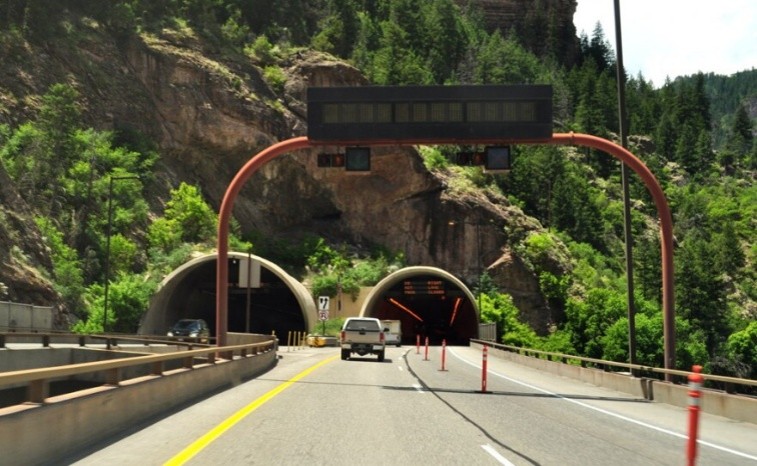
I know people get frustrated about the seemingly-continuous lane closures, work zones, and lower speed limits, especially on I-70 between Grand Junction and Denver. Some have even called for the resignation of CDOT Executive Director Shoshana Lew, citing the hours of wasted time caused by traffic delays. That is totally unfair. If people only understood the difficulty of picking up traffic cones, they would happily accept the extra hours of travel time.
When I was a kid, before I-70 was built, the trip from Grand Junction to Denver took an average of 6 hours. After completion of the final leg through Glenwood Canyon, that trip was shortened to an average of 3½ hours. Today after working so hard on the problem for several years, CDOT has finally expanded the trip back to 6 hours for many people – what an achievement! During construction in the canyon in the 1980s, we usually got to stop for a half hour to admire the scenery. Today we can often do that again instead of just whizzing by without noticing.
Chronic complainers gripe that lanes are frequently closed in “work zones” for miles without any apparent “work” underway. I understand the concern – I’ve seen it myself. Three times in as many weeks I’ve made that trip myself, twice in 6 hours and once in 5. One lane was closed all 12 miles through Glenwood Canyon, and another for the entire downhill side of Vail Pass, roughly ten more miles, both places adding 45 minutes of stop-and-go (mostly-stopped) traffic, and no construction in either place. Added to the ongoing work at Floyd Hill and 17 other work sites over those 230 miles, I got to enjoy lots of scenery that others may not fully appreciate.
Some folks think their time is more valuable than it is. Consider the high cost of putting down and picking up the traffic cones, often estimated to be $500-1500 each time, even though the process is more automated nowadays with truck-mounted attenuators and cone setters. Compare that with the minor delay in people’s driving time, rarely more than a couple extra hours. Figure that the average driver’s time is worth about $25 an hour. And how many drivers are there, anyway?
The Eisenhower Tunnel sees no more than 12.64 million vehicles in a year, so only about 34,600 per day. OK, maybe up to 40,092 in the summer months when construction is scheduled. Vail Pass has considerably less, only 23,000 vehicles per day including about 2,400 trucks. Glenwood Canyon sees slightly more at 25,800 vehicles per day. So, if a lane in the Hanging Lake Tunnel is closed for 3 weeks, as I have observed, half of those 25,800 vehicles that were westbound, for 21 days, would only affect 270,900 westbound vehicles.
Even if those people’s time is valued at $25 per hour, which is more than the minimum wage, and the delay was a full hour (as I experienced last weekend) that’s still only $322,500 in lost time per hour, and there’s no way to know how many travelers had to wait the entire hour. What’s a few hundred thousand dollars in lost time for ordinary people compared to the hundreds of dollars and minutes of time it would take CDOT to remove the cones and put them back again the next time construction work requires it?
Even if you add another hour that the same kind of no-construction delay took on Vail Pass, that might have cost motorists another $287,500, and the extra half-hour at the Eisenhower Tunnel perhaps another $1.002 million. That total trip with all 2.5 hours of delay could only have cost drivers about $1.6 million in lost time. But the cost of picking up and putting down traffic cones is between $500 and $1500 each time. CODT could only pick up and put back the cones about 1,000 times before it would have spent even more than the motorists lost!
A Silverthorne project illustrates common CDOT policy, announcing a continuous eastbound lane closure near Exit 205 for 5 days, with daytime work only from 7:00 to 5:30, but the lane closure and lower speed limit “continuous, day and night… to preserve the work area,” meaning for 13½ hours each night, the lane was closed with no construction work. Same obviously logical policy on the U.S.160 Project and others around the state.
It may be true that CDOT’s 2023 Standard Specifications for Road and Bridge Construction, Section 630.05 specifies that “Traffic cones shall not be used outside of working hours unattended.” But obviously contractors cannot be held to that rigid standard if it costs hundreds of dollars.
So next time you feel disgusted at how disrespectful of the public’s time Transportation Department officials may seem, put yourself in their shoes and look for solutions rather than complaints. Just ask yourself, where else are they going to put all those cones?


{ 1 comment… read it below or add one }
Funny,
Some. friends and I were driving to Gypsum to visit Costco a few weeks back and one of them commented that they thought CDOT was storing cones on the highway. I think you are both on to something here.