Colorado has often been called the “rooftop state” because the water that falls on Colorado flows to other states, with virtually none flowing in. Geologists call it a “headwaters state” because so much of the nation’s water supply originates in Colorado. Both distinctions have nuances, though.
Colorado is not entirely a headwaters state, because in fact small amounts of water do flow into Colorado from other states. The Little Snake originates in Colorado, flows back and forth across the Wyoming border 19 times, then finally empties into the Yampa. Vermillion Creek has very little water, but it originates in Wyoming, flowing 67 miles into the Green River. The Green itself rises in Wyoming, flows through Utah and into Colorado for 42 miles at Dinosaur National Monument before returning to Utah. And the Cimarron River flows about ten miles through the southeast corner of the state from Oklahoma and into Kansas.
Nor is Colorado the only state where all the water flows out – that is also true of Hawaii. In fact, the major differences for Colorado are primarily political and legal, not hydrological. The administration of water law is the real difference. That’s what makes Colorado absolutely unique, and it’s what puts Coloradans at such a disadvantage compared to every other state.
Consider the legal difference with the other “rooftop state.” All water that falls on Hawaii flows directly into the ocean, not into any other state, and Hawaii is legally entitled to use every drop if it wishes to do so. Hawaiians also deal with endangered species and instream flow rules, but no other state has any legal entitlement to its water.
By contrast, Coloradans are legally entitled to less than a third of the water that falls on their state, with all eight of its river basins subject to interstate compacts. There are 17 states, with a combined population of 139 million people, that depend at least partly on water originating in Colorado. Its largest river, the Colorado, directly supports 30 million people in seven states, and is also subject to an international treaty with Mexico.
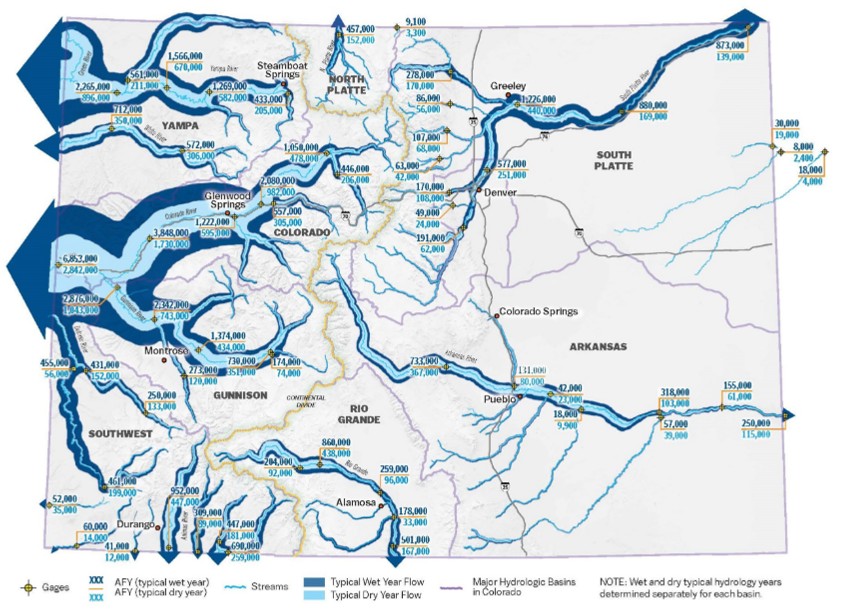
Use of the Arkansas River by farmers in southeastern Colorado led to a lawsuit from Kansas, whereby Colorado was forced to cut back its use. Nebraska is now suing for the right to dry up farms along the South Platte in northeast Colorado. Nevada is suing over management of the Colorado River, and Arizona is expected to join, demanding more than is available without further reducing legal Upper Basin uses.
No other state in the union is legally entitled to so little of its own resources as Colorado.
People ocassionally ask about Florida, Maine, and Michigan as states where virtually all the water flows out. But none of the three are subject to water rights held by people in other states. Some water flows into Florida’s panhandle, and the Apalachicola, Chattahoochee, and Flint Rivers were subject to an interstate compact with Georgia, but it was repealed in 2004 because the two could never agree on allocations. None of Florida’s water belongs to anyone else.
Neither does water originating in Maine or Michigan. None of Maine’s water flows into any other state. The St. Joseph River flows from Michigan into Indiana, but the latter has no legal claim to Michigan water. Both Michigan and Maine have water flowing to Canada that is subject to international agreements like the Colorado. But unlike the Colorado, their rivers have plenty of water and are not needed for irrigating farms in the desert or supporting massive cities like Los Angeles.
I would rather compare Colorado’s situation to California’s. Almost all California water flows into the Pacific Ocean and no other state can stop California from using nearly every drop – most of its instream flow requirements are self-imposed. It has three minor rivers (the Truckee, Carson, and Walker) that flow into Nevada, but they are a miniscule portion of California’s water, roughly 1.4 percent of the state’s estimated 71 million acre-feet of annual runoff.
That begs the comparison. California water authorities estimates its annual statewide runoff at 71 million acre-feet, where Colorado’s is perhaps 14-16 million acre-feet. Yet California is legally entitled to 4.4 million acre-feet from the Colorado River, while Colorado is limited to about 3.8 million acre-feet. Besides which, California occupies 840 miles of coastline on the world’s largest body of water.
Colorado’s perpetual dilemma is not just that it has so little water. It’s that Colorado is legally allowed to use so little of it.


{ 3 comments… read them below or add one }
Yep, California out votes us in congress by almost 8 to 1. Just like So Cal outvotes Nor Cal about the same. I remember when Biz Johnson always felt like his hands were tied as he represented Nor Cal and watched the water go south when the peripheral canal was built where the San Joaquin and Sacramento Rivers came together before Suisun Bay. What are we to do? Perhaps shut down the facility at Persigo Wash and stop wasting our dollars to clean up water before it leaves the state? Nah! probably some law against that. The truth of it is …. if we do not have the water …. that’s just the way it goes. I recently drove from Hartford to here and then here then to New York then Texas. I saw a lot of flooding. Perhaps it is time to bite the bullet and build the pipeline from the upper Great Lakes to the front range and replenish the Oglala aquifer. After all, Arizona is just dumping a lot of the Colorado River water into their ground water supply. In May as I led the tour of Studebakers the length of Route 66then home, I saw all the lush greenery of Beverly Hills and new orchards and vineyards on the high side of the Delta-Mendota Canal. That kind of waste must stop. While I see more drip irrigation in the San Joaquin and Sacramento Valleys, I still see a lot of flood irrigation still in use. That has got to stop! But…. we are outvoted. Where will it end? Thank you for speaking out for us Greg.
Steve
Water leads to development, and that is the basic reason for “first in use” rights. Water rights were the reward for putting water to use. Farmers and Ranchers were often the front end of state development and so they received the reward of rights to the water. That seems to be the major mis-understanding challenge for Coloradoans.
The eastern slope of Colorado has more rights to Colorado river water that the West slape origin side, for a few reasons.: 1. The Eastern slope had and created more uses for water / irrigation. 2. The Compact allows states to move water between basins and watersheds within their borders without limitation. And Colorado has done with great positive effect. The Front range would not have been able to grow as it has, without the trans-mountain & trans-basin diversion.
The productive use of water by farmers is also why California has such Sr. water rights. Before the the Compact California was using 80+% of the Colorado River water. The Compact re-allocated most of the California’s Sr. Rights to the other 6 Co. River basin states as part of the masterful Delph Carpenter Compact Plan. The California State farmers had little to say about the rights that were taken, so they moved on with what rights they were given. The good news is that most of the other 6 Colorado River basin states used their water to great effect. Las Vegas, and Phoenix would not exist with out the Colorado River projects as one example. So water rights, taken from California, have been put to good use. The entire country benefits! Big win.
Coloradoans need to understand that water rights are based on productive use, not just rain or snowfall. “Headwater” or “rooftop” state sounds good, but that is not where where water rights originate. It may take another trip to SCOTUS for People to learn that.
That’s mostly right, except that the irrigation rights in the Grand Valley are senior to almost all the transmountain diversions, including Denver’s.
{ 1 trackback }