I don’t know anyone else who tracks the number of federal cops, but the watchdog group Open the Books occasionally reports on the burgeoning number of federal agencies with law enforcement divisions. The latest report, “The Militarization of Federal Bureaucracy” detailed the astonishing scope of federal police power. There are over 200,000 federal officers with guns, badges, and arresting authority, in a whopping 103 different federal agencies. The federal government has more law enforcement officers than America’s 25 largest cities combined.
Those 103 federal agencies – half of which are not primarily law enforcement – spent $3.7 billion on guns, ammunition, and military-style equipment between 2006 and 2023. The FBI and ICE have always had that. But the National Institutes of Health in suburban Bethesda, Maryland now has its own fleet of police cars with cops who carry guns and can arrest people. So do the Bureau of Engraving and Printing, Library of Congress, National Park Service, Forest Service, Fish and Wildlife Service, Marine Fisheries Service, Government Printing Office, and the Bureau of Land Management (BLM).
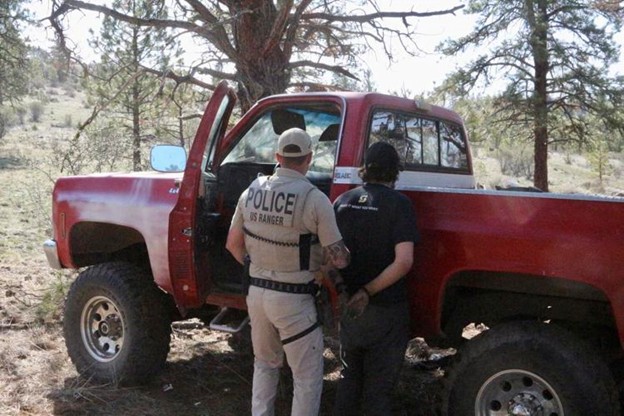
It is BLM law enforcement that has raised hackles across the West lately, prompting a major federal court case with far-reaching implications. That’s because the BLM has gone far beyond deploying cops to enforce laws. The agency has created its own laws – not typical land management regulations but criminal laws – then sent their own cops to enforce them.
The current case is so over-the-top it’s hard to believe, but it’s real. BLM used Federal Land Policy Management Act (FLPMA) authority to classify ordinary traffic violations as criminal offenses, subject to $1000 fines and jail time. A man in Moon Rocks, Nevada named Gregory Pheasant was caught riding a dirt bike at night on BLM land – an area where dirt bikes are allowed – with a broken taillight. Moon Rocks, Nevada isn’t the middle of nowhere – it is the end of nowhere. Never mind that there was no traffic issue, because dirt bikes in the desert do not encounter traffic, so there was no safety issue. Never mind that in every single state, including Nevada, a broken taillight is a traffic
violation, carrying a civil fine. In Colorado it’s a $15 ticket. But Mr. Pheasant was not given a ticket. He was arrested. Charged with a crime. Threatened with jail time.
To be clear, when Congress passed FLPMA in 1976 it granted BLM authority to issue regulations enforced by criminal penalties on BLM land. The legal question is whether Congress had the right to do that. Delegating enforcement authority is routine and expected. Delegating regulatory authority is another thing. But granting the authority to make criminal laws is yet another, and that is the question now before the Supreme Court. Mr. Pheasant sued, challenging Congress’s authority to delegate to any executive branch agency the power to decide what is a crime. The federal district judge agreed with Pheasant and dismissed the case. But no one has more lawyers than the government – BLM appealed, and the 9th Circuit Court of Appeals sided with Congress and BLM.
Even though BLM’s rule is wildly out of synch with state law, the Nevada Attorney General is running for Governor and didn’t want to take on the BLM and its allies. So, the State of Idaho took up the cause, joining Pheasant’s appeal to the U.S. Supreme Court. Idaho’s brief argues simply that, “The Constitution gives Congress the power to make laws and the Executive the duty to enforce them, but here Congress improperly handed the power to define crimes on public lands to the Bureau of Land Management.” Now joined by 20 other states, the plaintiffs explain that FLMPA allows BLM to make criminal laws on 245 million acres of public land without any meaningful limits, or even definitions, from Congress. The suit asks the Supreme Court to enforce the Constitutional requirement that elected representatives, not unelected employees, define criminal conduct, and to “restore the separation of powers the Founders designed.” The high court has yet to decide whether to hear the case.
I am a law-and-order guy. I think if a federal official sees someone breaking the law, something that threatens public safety, they should call the police. There are 3,144 counties in America and every one has a sheriff with a gun, badge, and arresting authority. They can easily handle traffic violations, even broken taillights. But they don’t get to make the laws, they enforce them. That’s the way it should work, at every level of government – even the BLM.


The USFS is one of the oldest Federal Agency’s with law enforcement authority. In 1910 USFS Rangers wore the “Pine Tree Badge” and had law enforcement responsibility on National Forest land. The same is true today! Not much has changed for the USFS.
Comments on this entry are closed.