The Wall Street Journal headline said “San Diego Now Has So Much Water That It’s Selling It.” The article said San Diego generates enough water to rescue Arizona, though that’s jumping the gun just a bit. No such deal has actually been finalized yet, but the fact that the conversation is underway marks a new era in Colorado River negotiations. And not a minute too soon.
The latest optimism is not based on any change in the historically low flow of the Colorado River. It’s based on the realization – at long last – that California does not need Colorado River water. That realization has finally come not only to Upper Basin states like Colorado (which has been making this point for decades) but to all of the seven states in the Colorado River Basin, which are entitled to various amounts of river water allocated by a century-old interstate compact and several other legal agreements.
California occupies 840 miles of coastline on the world’s largest body of water, the Pacific Ocean. The issue of desalination has risen to the top of the agenda for other Basin States now for two reasons. First, the inability of the states to reach an agreement on drastic reductions in their water use requires them to focus on other alternatives. Second, the oceanside Claude “Bud” Lewis Carlsbad desalination plant in San Diego County has completed a series of upgrades that may be game-changing.
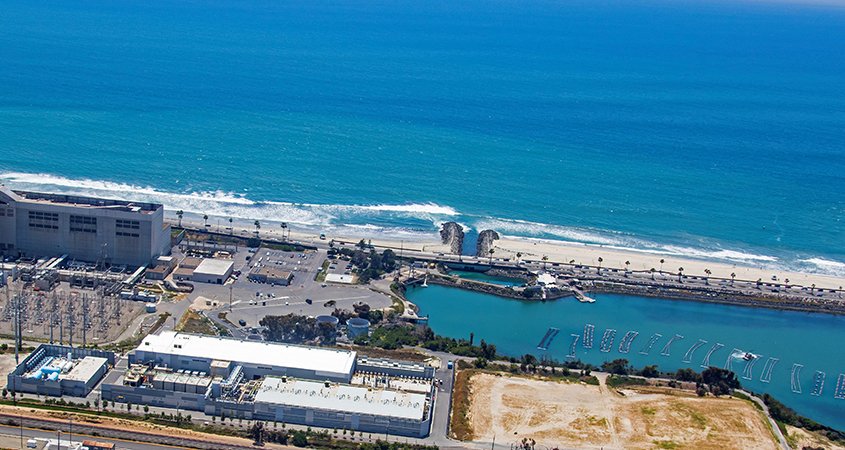
Compared to other desalination plants around the world, the Carlsbad facility is relatively small. But for California, it represents a giant leap. The plant was constructed in 2015 to convert seawater from the nearby Encina Powerplant. After Encina shut down in 2018, the desalination plant had to make significant upgrades to replace that water with ocean water, upgrades just recently completed.
San Diego’s unique situation led to a serious effort that took years. During a drought in the early 1990s, San Diego lost a third of its allocation, which came almost entirely from the Colorado River. That prompted major investments, including enlarging a dam and buying agricultural water rights from the Imperial Valley. It also led to serious investment in the Carlsbad desalination plant, which can now produce about 50 million gallons per day. That is extraordinarily modest compared to other such plants around the world.
Desalination on a commercial scale began in Saudi Arabia in 1907 with a coal-powered distillation machine. Technical advancements over the decades led to establishing the Saline Water Conversion Corporation in 1965, now the world’s largest producer of desalinated seawater, with a capacity of 1.32 billion gallons per day. That’s equal to 26 of the San Diego plants.
Worldwide, there are more than 18,000 desalination plants, producing 25 billion gallons a day for 300 million people. That’s almost 10 times the population of California, and the volume of desalinated water represents about 30 million acre feet – more than double the entire flow of the Colorado River.
In 2023 the California Coastal Commission rejected the Poseidon desalination project, which was 20 years in the planning and would have supplied another 50 million gallons a day. The Commission cited, among other factors, the “high cost of the water and lack of local demand for it…” While Los Angeles estimated its demand at 500,000 acre feet a year, or 447 million gallons a day.
Some reports show that even the new plant in San Diego has run below maximum capacity because “imported water sources” were cheaper. That is, in a nutshell, the main reason California has long refused to talk seriously about desalination, even though it is a central part of the State’s long-term water plan. Taking more from the Colorado River is cheaper, and the impact on other states just doesn’t matter to some California water leaders, though with a $4.1 trillion economy money is really no obstacle. California’s economy is four times larger than Saudi Arabia’s.
Still, the success of the San Diego plant has now led Arizona and Nevada to suggest that other states could help finance such projects. The federal government could also help share costs, and water exchanges could then leave millions of acre feet of water in the River for the other states – states that do not have oceans – while possibly refilling Lake Mead and Lake Powell. One San Diego water manager explained simply, “You’ve got to be able to move water from where it is to where it’s needed.”
Despite recent gloomy predictions, there may be more hope than ever, by looking further West to where the water is – the ocean.


Thank you for this article, Greg. This is good news and should be spread far and wide!! I know Israel has amazing technology in desalinization too.
Lisa
Comments on this entry are closed.
{ 1 trackback }