The Colorado legislature can only meet for 120 days a year, every legislator can only introduce five bills, bills must be passed by the 90th day, new programs must have a sunset clause, all meetings must be public and documents available for everyone to read. Except for the exceptions. Forty states have similar constraints, because they understand that limiting the legislature’s size, scope, and time is one way to guard against legislative misbehavior.
The Colorado legislature, composed of exactly 100 members, limits senators and representatives to 5 bills each, implying that a maximum of 500 bills could be considered during any two-year session. But the legislature regularly considers 700 bills or more, because there are exceptions. The 5-bill limit does not include bills that come from committees rather than individual members, nor appropriation bills, nor any bills for which the leadership decides to make an exception. Worse yet, the leadership can wave all the deadlines and grant “late bill status” at their sole discretion.
That is the source of untold chicanery every year. The House and Senate both have a “Committee on Delayed Bills” composed of three people: the top two leaders of the majority party and the minority leader. Permission to wave deadlines and introduce legislation at the last minute requires approval of only two, so it has become a common tool for the majority party, often used to short-circuit the public process otherwise required.
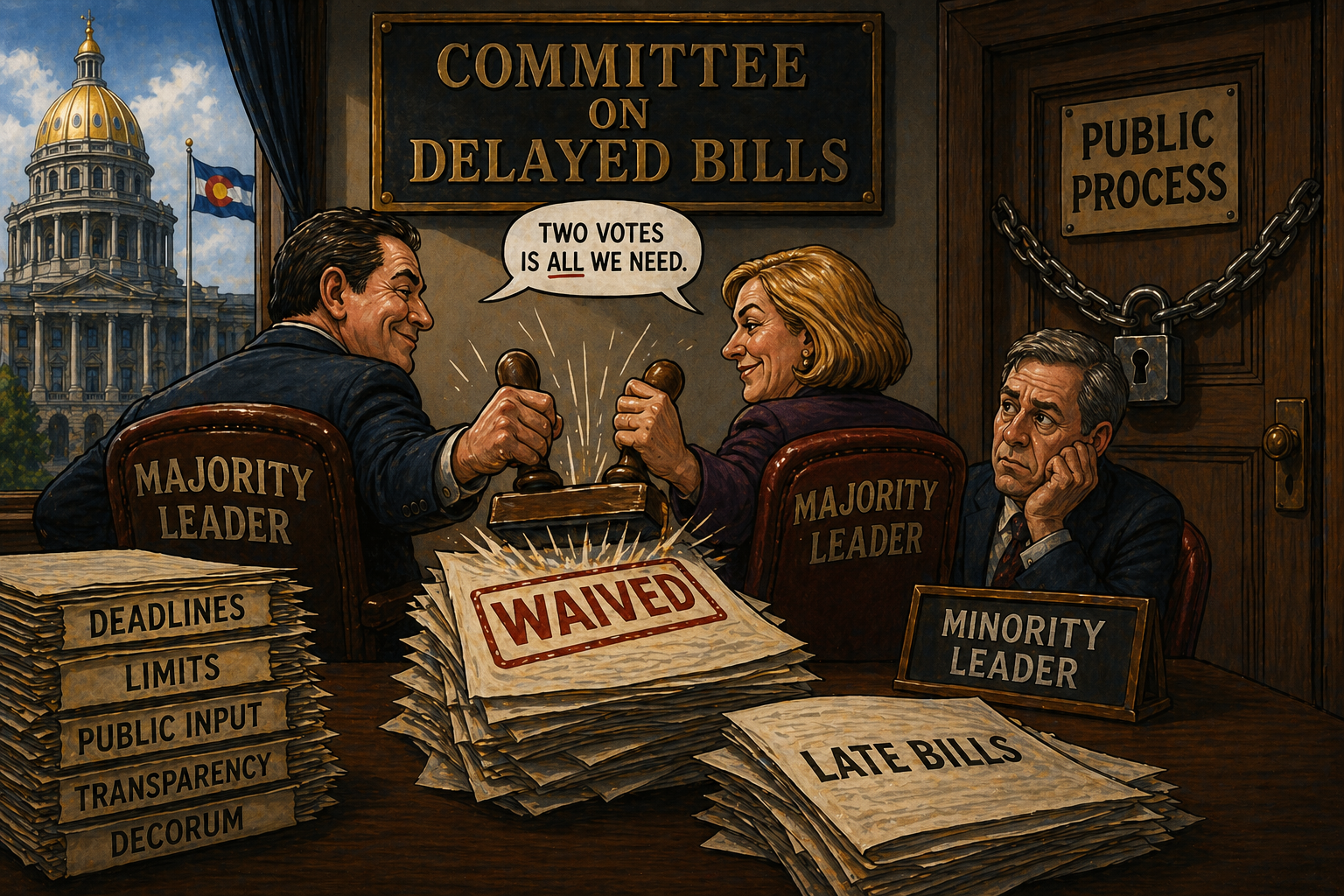
This session, House Speaker Julie McCluskie (D-Dillon) has introduced 9 bills, for example. In addition, she has been posturing to introduce legislation that would change Colorado’s historic laws governing ownership of streambanks and riverbeds. Under Colorado law, the waters of the state belong to the people, but the land under rivers belongs to the adjacent landowner. This is an issue state leaders grapple with every few years, because some organizations demand the “right to float” on streams crossing private property.
A right to float may exist, but touching the streambeds or banks on private property, without permission, is trespassing. McCluskie’s anticipated legislation would change that, with potentially multi-billion-dollar economic consequences. It is an enormously complicated legal issue, about which Common Sense Institute recently published a series of three studies outlining the complexities. There is no simple one-size-fits-all solution, so conflicts in Colorado are resolved on a mediated case-by-case basis.
Before changing 150 years of private property and water law, the legislature must carefully weigh the possible costs of litigation, the constitutional requirement to pay for “taking” private property for public purposes, and the impact on the tax base of dozens of counties. Not to mention the difficulty of determining which stream segments are both private and floatable, for which there is no database. The Common Sense Institute studies also concluded that the value of property that might be taken under such legislation would be in the billions.
The current state legislature convened on January 8, 2025, met for 120 days, convened its second session on January 14, 2026, and must adjourn permanently by May 13. McCluskie had well over a year to draft and introduce legislation, schedule hearings, consider testimony on both sides, weigh the complex legalities, seek guidance from agencies, and talk to interested groups. Instead, she granted “late bill status” on the issue and has declined to circulate any bill language that anyone could examine. As of today, less than three weeks from adjournment, with both Houses deep into the final passage stage on almost all legislation, no bill text has been printed for anyone to see. No hearings, no witnesses, no votes.
Interest groups pushing to change the law have been lobbying for months, while also declining to share any specific text. The strategy is purposely designed to avoid public scrutiny and legal analysis, to bypass the legislative process. Rushing major legislation through at the last minute, before interested parties know exactly what it would do, is an affront to the democratic system. It is an insult to every legislator who must vote on it without the benefit of public discussion and debate.
Even with a short-circuited process, bills cannot pass both houses in fewer than 8-10 days. Even the clever late bill strategy has limits and McCluskie is quickly running out of time before the May 13 adjournment. She should end the speculative posturing and make it clear that there will be no end-run around the process. This issue is not going away. Legislation can be introduced at the beginning of the next session and go through the same public process as any other major new law.
The Constitutional 120-day limit on the Colorado legislature was intended to prevent precisely this kind of mischief.


Greg: As always thanks for your comments and links. Colorado has been overrun with agendas wholly lacking substantive and procedural common sense. When are common sense folks going to elect common sense reps and a governor! An additional way such legislation will cost big time is in legal fees… unless the float operators and their customers are wholly exempt from liability. Gerry
What is the old joke, ,”Im from the government im here to help”.
,
Comments on this entry are closed.