People often ask me what “consultants” like me actually do. It’s a logical question because there is such a fine line between “self-employed” and “unemployed.” And there are as many different types of consulting as there are consultants. Sometimes I get paid to write: newspaper columns, studies, grants, reports, op-eds, speeches, and other materials. Sometimes people ask me for political advice, or to arrange meetings with public officials, or help solve problems with government agencies.
There will never be a shortage of people who have problems with government agencies. That’s nobody’s fault, just the nature of government to oppose virtually everything everyone wants to do everywhere. The challenge for citizens and businesses is to find ways to get things done, generally in spite of the government, not with its help. Or at least not with its enthusiastic encouragement.
We have evolved into a society that requires government permits for a vast array of projects, from building a business to replacing windows in our homes. A large majority of permits are required by local and state governments, but at the federal level there is a dizzying range of laws that require permits from various agencies. Just to name a few: the Clean Air Act; Clean Water Act; Safe Drinking Water Act; National Environmental Policy Act; Endangered Species Act; National Historic Preservation Act; Resource Conservation and Recovery Act; Comprehensive Environmental Response, Compensation and Liability Act; Federal Insecticide, Fungicide, and Rodenticide Act; Federal Food, Drug and Cosmetic Act; Federal Power Act; Animal Health Protection Act; Fishery Conservation and Management Act; Agriculture Marketing Act; and even the Commercial Transportation of Equines to Slaughter Act. There are more than 50 others, along with thousands of permit-requiring regulations created by executive branch agencies, not Congress. Permits are required for building roads, bridges, pipelines, transmission lines, powerplants, refineries, renewable energy facilities, dams, levies, canals, flood control systems, any project that touches wetlands or waterways, and any project that disturbs more than one acre of land.
In every case, Congress had good intentions when passing these laws, especially wanting to ensure public health and safety. Congress charged various agencies with enforcing the laws and issuing (or denying) permits, and it almost always included timelines and deadlines for agency actions. Congress never intended that the permit system would add years to construction projects, or millions to their costs, much less that the permit system itself would become the primary tool for stopping things. But that’s where we are today.
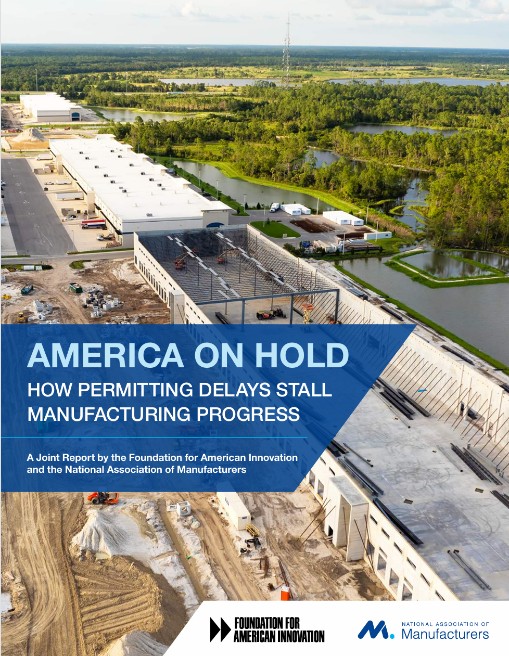
A recent report from the National Association of Manufacturers (NAM) and the Foundation for American Innovation showed that federal permitting alone adds roughly $8 billion per year to the cost of infrastructure and manufacturing projects. “It takes the U.S. up to 80 percent longer than our peer nations to move projects forward,” says the report. And perhaps surprisingly, most of those delays are in permitting facility expansions and equipment upgrades, not giant new projects.
Politicians claim they want to return manufacturing to the United States, but they have created a permitting process that does the opposite. Many companies have stopped trying, with over 50 percent saying the permitting process discourages them from investing in new or expanded capacity. 66 percent say they would increase U.S. investment if permitting was faster and more predictable. A McKinsey report found over 650 infrastructure projects awaiting federal permits.
Numerous politicians have tried to reform the permitting process for decades, but can never seem to get enough votes in Congress. Another attempt is underway now, called the Bipartisan American Affordability and Jobs Act,” sponsored by two senators from each party. It would impose two-year deadlines for environmental impact statements, 150-day deadlines for legal challenges, and protect already-issued permits from such lawsuits. It would end the need for major reviews of routine upgrades, reserving the complex NEPA process for major expansions and new facilities. It would stop states from vetoing projects that meet water quality standards. It would stop agencies from treating different kinds of energy projects differently just to satisfy some political agenda. Such changes would jump-start dozens of projects, from new refineries and upgraded powerplants to transmission and pipelines – which would do more to lower gas prices and utility rates than anything else Congress could do. It would facilitate desperately needed highway and bridge improvements, dam repairs, and inner-city renewals.
The bill was set for votes this year, but after the election, newly-empowered Democratic leaders suggested it will more likely languish in committees like all the other attempts in recent years. That will demonstrate whether politicians are serious about fixing infrastructure and bringing back manufacturing jobs. Paraphrasing NAM President Jay Timmons, America needs ribbon cuttings, not red tape.


{ 0 comments… add one now }