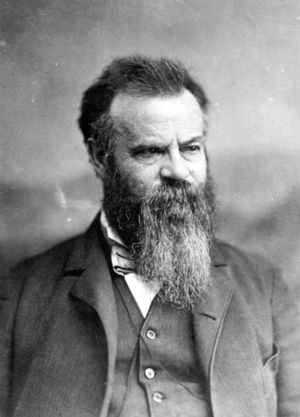
John Wesley Powell, the 19th Century Colorado River explorer, long-time head of the U.S. Geological Survey, and one-armed veteran of the Battle of Shiloh, published one of the earliest analyses of the American Southwest in 1879, called “Report on the Lands of the Arid Region of the United States.” He may have been the first to figure out that the limiting factor for settlement and growth in the West would never be land, but always water. It would be just as prescient if written last week. As he predicted, the modern prosperity of the West is built entirely on dams, canals, and irrigation – about which millions of its citizens are barely aware.
People focus on water slightly more during droughts. English clergyman Thomas Fuller published the proverb in 1732, “We never know the worth of water till the well is dry.”
There have been more articles and editorials about the Colorado River in the last two years than in the preceding two decades, because of the seven Basin states’ failure to reach agreement on future management of a dwindling water supply. Seeing no better option, the Interior Department published its “final” decision on management of Lake Powell, Lake Mead, and other major federal reservoirs over the next decade. A couple states are content, others angry, and one (Arizona) threatening litigation. So, recognizing that nothing related to the Colorado River is ever really “final,” what’s next, especially in the long-term?
The August 16 Wall Street Journal ran the headline, “The Colorado River is shrinking. See how authorities are trying to save it.” The story, with impressive color graphs, led with “After years of impasse between states, the federal government has stepped in to try to save the beleaguered Colorado River. The plans include a short-term fix for an ailing reservoir [Lake Powel] and longer-term efforts to keep the river flowing. It is unclear how effective these measures will be.”
Part of the problem is the disjointed nature of government, not the fault of anyone in particular. While Interior Department officials say they are doing what they can to “rescue the river,” one of the primary causes of reduced flows – the vast overgrowth of national forests – is under the jurisdiction of the Agriculture Department’s U.S. Forest Service. Interior officials cannot force the Forest Service to restore a more natural and healthy forest density and structure, even though
that might add hundreds of thousands of acre-feet of water to the river system. Interior’s Bureau of Land Management could lead the removal of tamarisk and other non-native invasive species that suck an estimated million acre-feet of water from the system annually – but BLM is only one of many landowners whose participation would be needed. The Bureau of Reclamation can and will adjust storage and flows at Lakes Powell and Mead, both of which are at their lowest levels in my lifetime, but that can only control outflow below dams. It cannot create new water flowing in.
However, there are ways to do exactly that. If the federal government were serious about forest management, and about removing invasive species, it could add millions of acre-feet, as already mentioned. But other methods could be faster and cheaper in the interim.
Last summer, the Lower Basin states (Arizona, Nevada and California) signed a memorandum of understanding with Interior to explore an interstate exchange network specifically designed to create more water in the system. Strategies include the largest potential of all, desalinated ocean water, along with advanced water recycling and reuse systems, groundwater recovery, and agricultural conservation through technological improvements.
The answer to Arizona/California water shortages is not fighting with the Upper Basin or federal officials. The answer is using good old-fashioned American innovation to create new water supplies. That is the conclusion of Jim Madaffer, vice chair of the Colorado River Board of California and a San Diego County Water Authority board member. He wrote an enlightened op-ed piece titled, “Subtraction isn’t the way out of the Colorado River crisis,” arguing that marketing water savings within the Lower Basin could lead to significantly more water in the river.
Madaffer’s piece attracted attention as an unusual full-throated endorsement of free market principles. Instead of the tired call for changing allocations established by the 1922 Interstate Compact – changes that will never be agreed upon by the Upper Basin – he instead proposes economic incentives to add water to the river by allowing states to supply their needs through other methods, including desalination.
By competing to create abundance, instead of allocating shortages, the Lower Basin can solve its water problem and continue to build an even more prosperous future. John Wesley Powell would be proud.


Great Aricle Greg! You know we here in Colorado are in the middle of a Governor election. There are those water bandits that are donating huge sums into Marx’s campaign. Sean Tonner is the main bandit. He and Owens have tried to take water from the San Luis Valley.
Yeah Greg it’s me again.
Point of interest:
Since 2010 I have been spending my winters in Overton Nevada. If your not familiar with the area it is a little town down by Lake Mead. We do a lot fishing, SxS riding, BS, etc. I have watched and experienced the depletion of Lake Mead since 2010. Twoo years ago when it was low getting the boat in the water was a challenge as the park service as most Gov Agencies had no budget to do do dock work at Echo Bay marina where we put in. Obviously this year is going to be even worse. I will admit however even with the low water that is still one big lake compared to here in Colorado. Oh by the way, fishing is about the same, high or low water.
Walt Blackburn
Comments on this entry are closed.
{ 1 trackback }