What if you face difficult legal battles, and I announce that I’ve appointed myself as your lawyer? We have never met, and I don’t know anything about your needs. You know nothing of my credentials. You never agreed to hire me or signed any contract. No matter, I’m representing you anyway.
What an absurd scenario – no thinking person hires a stranger to represent them without at least a conversation, a document, or a handshake. But what about a mountain, a tree, or a river? I can appoint myself to represent entire ecosystems, and who is going to challenge me?
Such absurdities are the basis of the “rights of nature” movement, a theory that the land should own itself. Land has its own rights – not just the intrinsic value we all agree nature has, but legal rights protected by law, like other property rights. Except that all property has an owner – that’s what property is. No property goes to court to protect itself. Property owners do that.
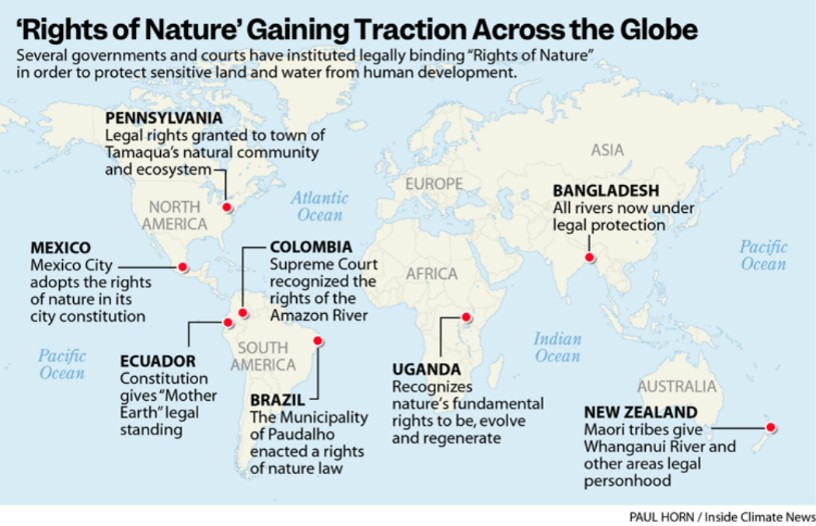
Who owns nature? The whole point of the “rights of nature” movement is that nobody does. Its adherents ask, “If a person, association, or corporation can have legal standing, why can’t a river or mountain?” The question displays breathtaking ignorance of 1000 years of common law, oblivious to the reality that property rights can only exist under a system of laws. Some authority must establish rules under which property can exist, and one must establish their property right under those rules. Mountains cannot do that because nobody can ask them, nor can they answer. No mountain ever filed a lawsuit; no river ever wrote a letter to its congressman; no tree ever spoke at a public hearing. What conceit can presume to speak for nature?
An especially strange tenet of the “rights of nature” movement is that indigenous tribes are the proper representatives of nature’s rights. Nobody asked them, but political activists (also presuming to speak for “indigenous people”) want to simply anoint them. One advocate, a New Zealand law professor, writes that “Traditional indigenous worldviews embody a connection with nature so deep that nature is regarded as a living ancestor.” She illogically concludes that, “From this worldview arises… the need for a legal structure that reflects a primary frame of responsibilities to the natural world as kin.”
Another leading advocate, environmental industry lawyer Thomas Linzey, explains, “Rights of nature, this concept that nature is not property and can’t be owned is, of course, an indigenous cosmovision that goes back many thousands of years.” Really? There is not a shred of evidence that any ancient people believed this. We don’t know what they believed.
Be skeptical of political activists who attribute their views to ancient indigenous traditions or claim the tribes have believed anything “for thousands of years.” Archeological evidence tells us, at most, where such tribes lived, where they migrated, what they ate, their hunting, gathering, or farming habits – but not their legal or political opinions.
There are exceptions. The Maya developed a writing system, and there are surviving pre-Columbian codices describing rulers, wars, and dynasties. The Aztec used pictographic record-keeping, and there are surviving codices dealing with landholding, boundaries, and property. Several surveys completed shortly after the Spanish conquest record individual landholdings, parcel boundaries, and the families associated with them, in both the Mayan and Aztec cultures. Any assertion that ancient indigenous people did not believe in private property is demonstrably false.
Even more recent tribal leaders like the Ute Chief Ouray most certainly held private property, in his case a farm of several hundred acres south of Montrose. So, the activists’ claim that the tribes believed nature owned itself dating back thousands of years, is an attempt to credit their own modern political views to historical people who are not around to object.
The American Bar Association identifies Christopher Stone’s 1972 article, “Should Trees Have Standing?” as the origin of the idea of granting legal rights to nature. Not ancient indigenous cultures. Today, the “Sacred Contract Coalition” appoints itself, “to enable Land and ecosystems to own themselves, be represented by indigenous led, multi-cultural guardianship councils, and assert their own legal rights.”
One modern attempt to push the legal envelope involves a 30-acre parcel in Saguache County, owned by the Manitou Foundation. Its leaders created on paper a group called the “Pyramid Mountain Association,” transferred the property to the latter, announcing that it has 5 owners: the soil, water, atmosphere, wildlife, and forest. Obviously, those are not legal entities that can sign papers, so legally its real owners are 5 actual people. Lindzey’s grandiose website boasts that through his work, “a 30-acre mountain in Colorado was recognized in June 2025 as the first mountain to own itself.” Recognized by whom? The Sacred Contract Coalition?
If natural landscapes cannot be owned by anyone, who gets to decide how those lands can be used? Who decides whether they are available for hunting and fishing – or for mining, logging, and grazing? Their self-appointed managers, of course. In short, these advocates don’t really want the land to have no owners at all – they want to be the owners.
Self-appointment works if there is nobody to challenge it. But then again, there is no one to accept it, either.


What about the rights of saplings that change their identities? And who
is going to defend the unborn acorn? This could be the start of a lucrative cottage industry!
Comments on this entry are closed.