Few images evoke more emotional symbolism than light. As far back as history records, light held a significant place in ancient cultures, many of which worshipped the sun. In the Christian faith, the “light of the world” symbolizes truth, divinity, knowledge, even life itself. That is the symbolic origin of Christmas lights on our houses.
We just took down our Christmas lights for the year, but if we lived in Maine we might never put them up again. Our neighborhood is seasonally lit up like one of those quaint little toy villages, but if we lived in Maine, we would be demonized for such “non-essential” lighting. An outright ban is coming soon, as Maine is now home to more Scrooges and Grinches than Dickens or Seuss could have imagined.
Maine just adopted the nation’s strictest anti-lighting law. Advocates promoted it as an effort to recapture what was once great about the night skies – something forever lost to the great evil of cities and their light pollution. These activists may not know it, living almost exclusively in the exclusive neighborhoods of large cities, but the night skies are still spectacular in most of the world, including Maine.
Stargazing is more popular than ever before, and telescope sales are growing because of rising public interest in astronomy, technological improvements, the rebirth of NASA, and even astro-tourism. Telescope sales are a $370 million industry in the U.S. alone and growing eight percent annually. Worldwide, 1.8 million telescopes were sold in 2023, so the idea that darkness is disappearing is simply uninformed.
This has been on the environmental industry wish list for years. A couple New Mexico astronomers in the 1980s formed the International Dark-Sky Association and tried to get their state to ban light in the “viewshed” of national parks, meaning the entire sky. They didn’t convince the state but got the National Park Service interested. A Division Chief named Joe Slovick wrote a memo titled “The night sky as a resource” which resulted in that idea becoming part of the agency’s permanent policies. He and a colleague coauthored an article titled, “Let There Be Dark: The National Park Service and the New Mexico Night Sky Protection Act,” which included this gem: “Did the NPS mission not, after all, require that present and future generations be allowed to view the same night sky that the Chacoans so carefully studied a thousand years ago?”
I’ve read the Park Service’s mission statement, and its original enabling law from 1916. And no, they do not mention Chaco culture, darkness, or night sky. Nevertheless, it is clear the agency now views night sky as a vital part of the natural and cultural resources of the park system. I’m good with that. National Parks are among the best places people go to watch the moon and stars. Yet somehow the idea has morphed from that obvious goal into an effort to make people in cities stop lighting their towns. The International Dark-Sky Association now presumes authority to declare “International Dark Sky Sanctuaries” like some government agency. Their latest is in Maine, and activists there are ecstatic. For a long time, dark sky advocates said they dreamed of looking out an airplane window and seeing nothing but darkness below.
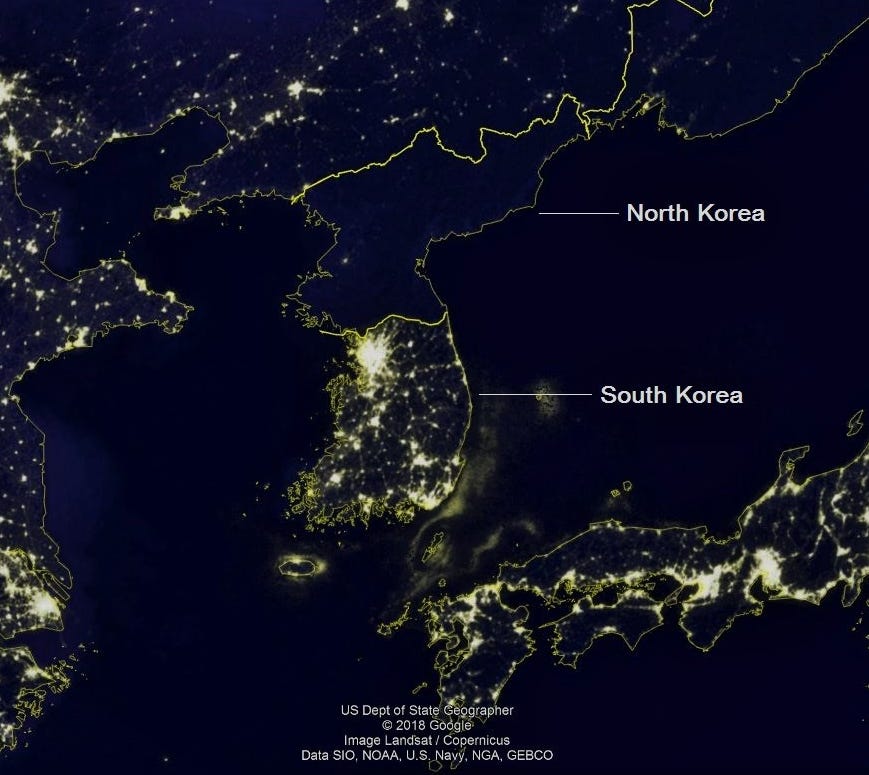
A friend of mine started saying they wanted Maine to look like the famous nighttime photos of North Korea, so they soon abandoned the airplane references. But not their goal. And now finally, they have convinced the state legislature to adopt a law known as H.P. 1295, “An Act to Promote Responsible Outdoor Lighting.”
The new law went into effect January 1 (without the Governor’s signature), banning Christmas “light pollution” and “light trespass” on public open spaces, and “non-essential lighting during nighttime hours.” That includes streetlights, schools, courthouses, and other public buildings, all of which are to be turned off at 10 pm, security concerns notwithstanding. The bill sponsor acknowledges that lighting is often for safety, but says, “It’s less safe to be too bright,” something she clearly needn’t worry about. Initially, the new law applies to public places, but with a strong emphasis on incentivizing private homeowners, too, the writing is on the wall.
Somehow the concept of freedom is lost in the noise. JFK’s classic inaugural address used the light metaphor: “The energy, the faith, the devotion which we bring to this endeavor will light our country and all who serve it, and the glow from that fire can truly light the world.” Except in Maine at Christmastime.


Comments on this entry are closed.