The 1998 final report of independent counsel Ken Starr’s investigation of President Clinton led to the first impeachment since 1868. But today the report is better remembered for Clinton’s response, buried in footnote 1128, “It depends on what the meaning of the word ‘is’ is.”
Pundits made fun of it, but there was nothing new about politicians playing with definitions. What constitutes a “navigable” water? What’s the difference between “threatened” and “endangered?” What is “social justice?”
Definition disputes are as old as politics. If the founders knew generations would argue about the Second Amendment, they might have defined it more clearly. They certainly would have done so with the Fifth. Writing that private property shall not be “taken” for public use without just compensation, they had no idea what government might eventually see as public use.
Today, local governments take property from one private owner and give it to another. They also take away the value of property by prohibiting its use, without taking the deed. The latter is called a “regulatory taking,” as distinguished from a “physical taking.” The founders would have recognized no difference in the affront to private property rights. Their descendants have argued about it for generations, and courts are all over the map.
The Murr family owned a house on a one-acre lot. The neighboring lot was vacant, and zoning rules allowed a house to be built there. The Murrs bought it to build a home for their daughter. The local zoning board later changed the rules and stopped them, combining the properties into one lot. That took away the $410,000 appraised value of the extra lot.
Jim Wickstra bought 3-acres on Lake Michigan to build a beach home. Then, the Legislature banned development along the lakefront and Wickstra’s permit was denied. The State admitted the property was worth $200,000 with a building permit, and only $500 without it. Yet Wickstra lost a decade-long battle to get compensation for the loss of $195,500 in property value.
In both cases, courts sided with the governments, saying the owners still retained some property value, albeit it reduced. Yet in other cases, courts have ruled exactly the opposite.
Coy Koontz tried to develop 3.7-acres of his property, offsetting a loss of wetlands by deeding a conservation easement on 11 acres, as the local law required. The conservation district instead demanded he reduce his development to one acre and put an easement on ALL the rest of his property. The Supreme Court ruled that he must be compensated for the property value taken.
Similarly, the court granted David Lucas compensation because a newly-enacted state law prohibiting him from building on his property had effectively “wiped out” all of the land’s value. The court called it an important precedent, but apparently sometimes it is and sometimes not.
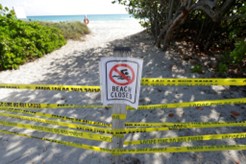
After years of uncertainty, the 11th Circuit Court of Appeals has issued a landmark ruling (Alford v. Walton County) clarifying that regulatory and physical takings both require compensation. Interestingly, it was the mandated COVID closures that created this case, because so many local governments forced owners to close properties. In Walton County, Florida, private beaches were ordered closed and the owners prohibited from using them.
The local district court ruled that prohibiting private owners from using their property was neither a regulatory nor physical taking, because the closure was a temporary emergency. The appellate court soundly rejected that argument. Here it was private beaches, but around the country we all remember similar scenarios.
The ordinance barred the owners from entering their property. Sheriff’s deputies physically occupied it, parked vehicles to bar entry, excluded the owners and others under threat of arrest and criminal prosecution. “In other words,” the higher court ruled, “Walton County wrested the rights to possess, use, and exclude from the landowners, and it took those rights for itself. That triggers the landowner’s right to just compensation.”
The court pointed out that the ordinance “prohibited the Landowners from physically accessing their beachfront property under any circumstances. That is different from a restriction on how the landowners could use property they otherwise physically possessed.” So finally, the Fifth Amendment has protected owners against such “taking,” even when the deed itself was not taken, even if the taking was temporary.
A regulation barring the owner was declared a physical taking, not just a regulation restricting use. That requires just compensation and to deny that is, as the court wrote, “to use words in a manner that deprives them of all their ordinary meaning.” The latest example of a court ruling that the Constitution actually means what it says.


Comments on this entry are closed.