A decade ago, three giant companies took advantage of federal incentives to build the world’s largest solar power plant in the Mojave Desert, known as Ivanpah. It was “the wave of the future,” a new technology that focuses 300,000 computer-controlled mirrors to reflect solar rays onto three boiler towers, each the height of a 40-story building. The water inside is heated to produce steam that can generate 392 megawatts, enough electricity to power 140,000 homes. Supposed to last 30 years or more, the technology is already considered obsolete. Obama Administration loan guarantees financed three-fourths of the $2.2 billion cost, making it a safe investment for the three owners – Google, BrightSource Energy, and NRG Energy.

I wrote a column at the time about the Ivanpah facility “frying birds in midair,” because the extreme light it generates draws millions of insects, which in turn draws millions of birds. The effect of focusing the sun’s rays is the same as when a schoolboy focuses a magnifying glass on ants, and birds are literally burned in midair. Solar advocates made fun of my accusation at the time, though it is widely acknowledged today. The Association of Avian Veterinarians says the plant “is believed to be responsible for at least 6,000 bird deaths each year.”
Despite Ivanpah’s impact on birds, the environmental disaster is almost a distraction, considering the economic boondoggle it turned out to be. The plant does not generate the power it promised, is far less energy efficient than expected, and costs much more to maintain.
In addition, its professed role in weaning America from fossil fuels is belied by the fact that the plant cannot operate without natural gas. Lots of natural gas. That’s because focusing intense solar rays on boilers that cool overnight causes them to crack, so they must first be preheated to about 500 degrees every morning. Gas is also required to maintain heat and pressure when the sun isn’t shining, and to keep components from freezing during cold nights. The builders originally thought natural gas might supply 5 percent of the plant’s energy, but it has been more like 25 percent. The plant has used upwards of 1.4 billion cubic feet of natural gas annually, enough to generate 95,000 megawatt hours of electricity on its own, almost a quarter of the plant’s total output. Sometimes even the most ardent advocates of solar energy are confronted by the reality that the sun doesn’t always shine.
The resulting inefficiency and high cost have now prompted the plant’s primary customer, Pacific Gas & Electric, to cancel its contracts, which were scheduled to run through 2039, because other sources of energy are cheaper and therefore better for consumers. Ivanpah is to be shut down.
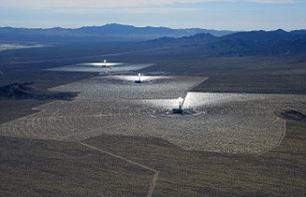
The future of the site is uncertain. The operator vaguely says the deactivation may provide “an opportunity for the site to potentially be repurposed for more conventional renewable energy (for example, photovoltaics).” But BLM’s 2005 environmental impact statement for the project required a “Closure, Revegetation and Rehabilitation Plan,” which said when the plant closed the owners must implement a plan to restore the land and remove equipment. We don’t yet know who might pay for that.
What is even less clear is the fate of the federal loan guarantees. The three investors created Solar Partners I, LLC, and if that entity cannot make its loan payments, the Department of Energy must honor the federal guarantee and pay back the lender. And the lender was – the government (Federal Financing Bank). So, the taxpayers may have to pay back the taxpayer-subsidized revolving fund.
What about the LLC’s owners themselves? DOE can pursue recovery from the project’s assets, but the investors had clever lawyers. NRG, Google, and BrightSource are not directly liable for loan repayment like personal guarantors would be. All three are probably liable only up to their actual equity investment, but since most of the money came from the government, none of them have much equity in it. As the lead sponsor, NRG Energy Inc. had to guarantee the project would be finished and operational. Once that was done, NRG’s guarantee obligations probably expired. Google invested about $168 million, the equivalent of $1 for ordinary people like me. Even so, Google was not a debt guarantor, so it could lose its investment but would owe the government nothing if Ivanpah defaults. BrightSource only provided the equipment, so it can only lose its equity, and might be liable for warranties on its equipment (which has not failed) – but not for the federal debt.
For now, the government isn’t saying how much of the loan has been repaid and how much is still owed. But whatever that amount is, it doesn’t take much imagination to figure out who will ultimately pay it.


Comments on this entry are closed.