When Congress authorized nearly $400 billion in climate subsidies, the bill was called the “Inflation Reduction Act,” though it had nothing to do with inflation. The 2001 “Patriot Act” was about expanding government surveillance powers, not patriotism. The massive new federal health insurance program was called “Affordable Care Act,” though it did not reduce the cost of anything. And we call laws restricting mandatory union contracts “right to work,” though they create no jobs.
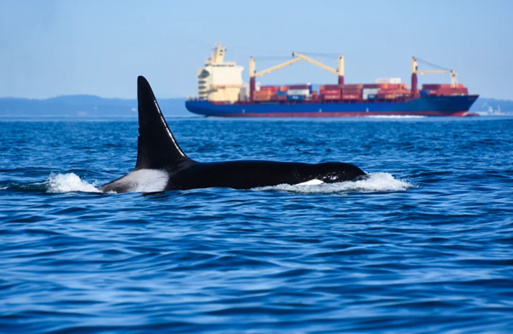
Popular-sounding names enhance the chances of acceptance for many proposals that might otherwise fail the test of public opinion. Calling a new program of government regulations, fees, and permits a “market-based solution” might appeal to folks who would otherwise oppose it. That may be the strategy behind a fascinating new analysis of the impact giant merchant ships have on killer whale populations.
It is a proposal written by M. Scott Taylor and published by my friends at the Property and Environment Research Center (PERC) in Montana. It’s titled “Saving Killer Whales Without Sinking Trade,” and calls its suggestion “a market solution to noise pollution.” Few whale observers have drawn direct links between the noise of giant ships and the health of killer whales. But there may be a closer relationship than previously suspected.
Scott Taylor is a great writer, a renowned Canadian economist who has studied, researched, and taught at universities around the world and published numerous scholarly articles. He has a self-described reputation for “the use of novel methods and data to evaluate hypotheses that were previously unexplored,” meaning new and untested. Such as exploring this shipping noise issue.
Worldwide, the maritime shipping fleet is huge – an estimated 112,500 commercial ships with more than 2 billion tons of freight capacity. We know ocean noise levels increased somewhat because of the expansion of shipping between 1950 and 1980 but have remained relatively stable since then because of improved technology. Oceans cover almost 70 percent of the globe so there is plenty of room, but as Taylor points out, “the same nutrient-rich coastal waters favored by whales are also home to many of the world’s busiest shipping lanes.”
Several studies have documented changes in whale behavior when ships are close. Behavior yes, but health and even death? That’s new. And it’s hard to prove. Taylor explains, “although whales increase the amplitude of their calls when vessels are near, alter their travel paths, and change their hunting and socializing behavior, it remains an open question whether these changes are important to whale health or just minor inconveniences.”
That’s where his new analysis gets interesting and “novel.” Linking whale populations to shipping noise requires finding a place where shipping noise has increased significantly, where killer whales also thrive, and where that whale population can be documented before and after the shipping increased.
Taylor found such a place, in the Puget Sound region. His method is meticulous and complex, intriguing reading even for amateurs like me, and he makes a fairly persuasive case that killer whales tend to die younger where there is more shipping noise. The controversy begins when he proposes what he terms “a market-based solution that prices underwater noise pollution… and offers a cost-effective alternative to traditional command-and-control policies… and incentives for innovation and compliance.”
Yet the proposed incentive for compliance is not novel. It’s as old as government: rules, regulations, and permits. We already have rules against ships getting too close to killer whales. And most shippers observe a voluntary Washington state program that encourages slower speeds in whale areas. But Taylor wants to create “a market in underwater noise pollution permits” that is all-too reminiscent of the fraud created by “carbon credit” markets – a comparison he himself draws. If a company pollutes the air, it can be fined, or it can simply buy carbon credits and continue polluting.
But there is no accepted measure for ocean noise, unlike emissions from industrial plants, measured in tons of CO2 or other pollutants. So, Taylor invents a noise pollution unit, based on the number of hours a ship “disturbs” one cubic kilometer in the sea, a clever approach. Governments would issue permits for those noise units, which shipping companies could buy and sell. But such permits would have marketable value only if the government required them – and limited their number. I love free enterprise and free markets, but I don’t love using government’s power to influence the market.
Taylor is right – this fascinating new issue calls for new ideas and perhaps market solutions. Unfortunately, this idea is neither new nor market based. It needs more work.


Comments on this entry are closed.