Western newspapers, blogs, and podcasts are humming this month with stories that the seven states on the Colorado River are close to an agreement on managing the River in future years. The existing agreements, designed to “supplement” the ancient and sacred Interstate Compact during drought years, are set to expire at the end of 2026, and the federal government has issued dire warnings about its impending take-over, should states fail to come up with an “acceptable” plan. An agreement may be close.
Over the past nine years I have written 16 columns about these perpetual negotiations, and the consistently over-reaching federal role in the River’s management. I regularly take issue with both federal and state responses to the diminished flow of the River, compared to the flows expected by the century-old Interstate Compact that governs distribution of its waters. To the point that I often recall the famous Voltaire statement, “It is dangerous to be right in matters on which the established authorities are wrong.”
Admittedly, I was for a while one of those “established authorities,” as Colorado’s lead negotiator while serving as Executive Director of the state’s Department of Natural Resources. That was 20 years ago but even then, the solution was obvious, and though I was sometimes the only one naïve enough (brave enough?) to say it out loud, I certainly wasn’t the only one thinking it. I recently asked OpenAI’s ChatGPT how to explain that, and it came back with this gem: “Sometimes the truth is so obvious it hides in plain sight – ignored, not because it’s hidden, but because it’s uncomfortable.”
The simple solution has never been rewriting the interstate compact, as California has always wanted to do, but simply to distribute the water by the existing percentages – based on the River’s actual flow.
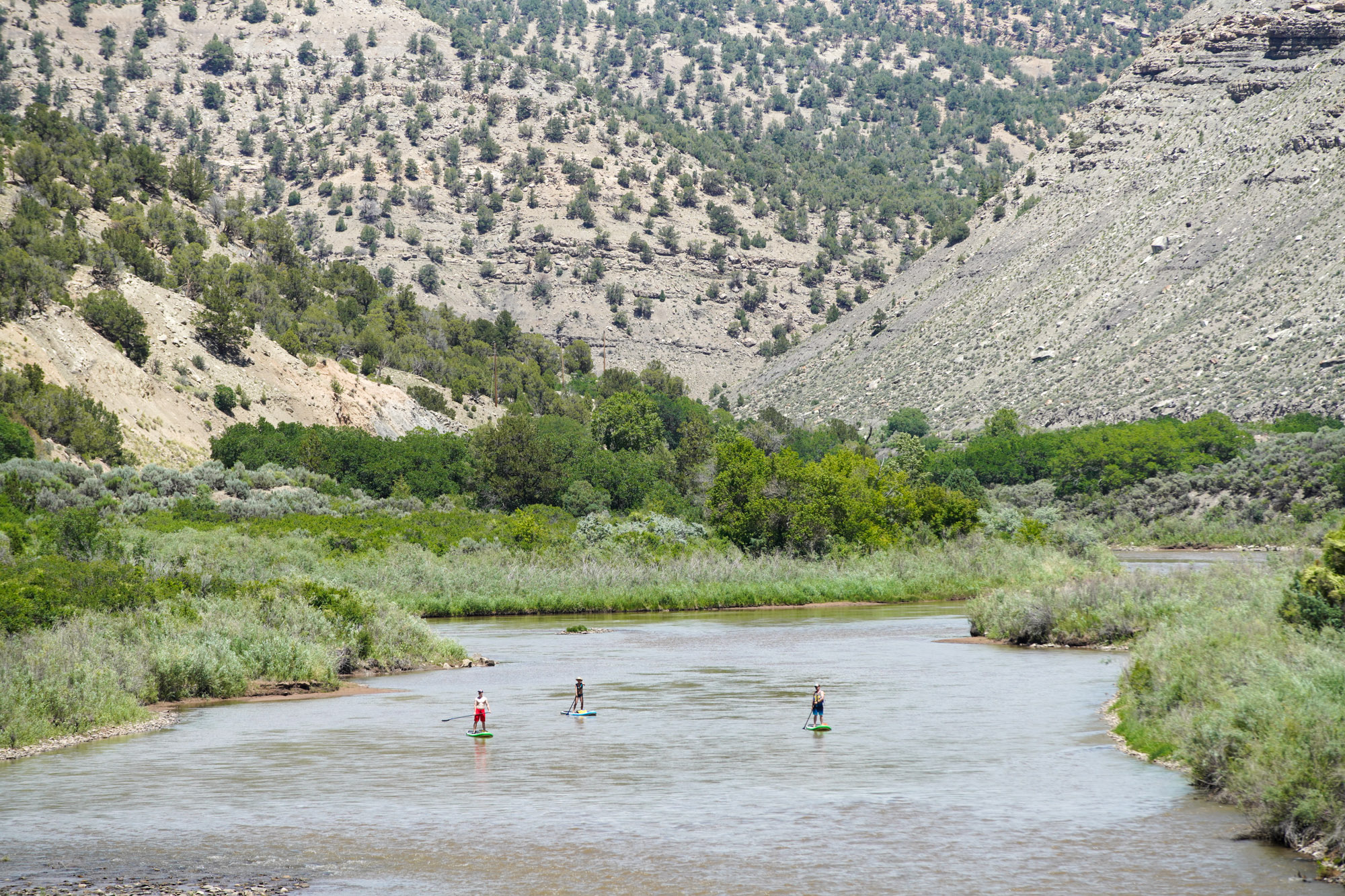
You see, the 1922 Compact divided the Colorado River’s water between Upper and Lower Basins, half the water allocated to each. The allocations were based on an annual flow of about 15 million acre-feet (MAF), the historical average at the time. The Lower Basin states of California, Nevada, and Arizona were allocated 7.5 MAF of water, as were the Upper Basin states of Colorado, Wyoming, Utah, and New Mexico.
Today the major issue is no more complicated than that the River’s flow is less than 15 MAF, perhaps 13. Other states and the federal government invariably say Colorado will just have to “conserve” more (i.e. use less). I started saying and writing years ago that the easier solution is to
leave the formulas and percentages the same, leaving the Compact unchanged, but simply adjusting every state’s entitlement to reflect the actual flow. That would make the Lower Basin share 6.5 MAF, not 7.5, and California would get 3.8, not the 4.4 it has always been allotted.
Colorado is the only state that uses less than its legal entitlement, so the other states never entertained that idea for a second. But today, with increased pressure because the current agreements are soon expiring, it may finally be the idea whose time has come. The seven states are now discussing tentative plans that would base reservoir releases on the amount of water actually flowing in the river. They say the “new concept would be more responsive as river flows become more variable.” Setting aside the irony of calling it “new,” it is exactly the right approach.
One former official warns that “the devil’s in the details.” Meaning the states would have to decide how to calculate the river’s natural flow, and what the various state percentages should be. The latter should pose no difficulty at all if the original Compact allocations are used.
As the states move toward final agreement, two central points must remain in focus.
First, all the other states have zero sympathy for California, which has always enjoyed an unfair advantage – 840 miles of coastline on the Earth’s largest body of water. The state can claim that desalination is challenging, but it also has the world’s fifth largest economy, with a GDP of $2.6 trillion. Californians do not need more water from the Colorado River.
Second, this is a decision for the states whose future is at stake, not for the federal government. The Interior Department continually threatens to take control away from the states, based on highly questionable legal authority, at best. Even a current Interior Department appointee, speaking at the Colorado Water Congress, recently touted the Secretary’s role as “water master” and threatened a takeover if states don’t quickly agree. But under relevant statutes and court rulings, the Secretary is “water master” only in the Lower Basin, with no authority whatsoever to tell Upper Basin states how to distribute their water.
All the states must push back against such edicts and threats, and push ahead with their own work – especially when they are finally so close to what has always been the right solution.


Does Texas or Oklahoma give away, free, their natural resources (oil and natural gas) to other states? No, of course not. They rake in tens of billions of dollars selling it across the country. They just so happen to be lucky enough to sit on top of these valuable resources. So why should Colorado give away, free, their natural resources (water) to other states? I don’t get why Colorado should be treated differently. We should be charging for it’s water.
Common sense seems so hard when politics is involved.
As a resident of Southwest New Mexico I have always asserted that we need more higher elevation storage facilities rather than the lower elevation reservoirs that have extremely high evaporation rates. These facilities could store water during high monsoon events and release during high demand months.
I have often asserted that at some point the lower basin states will be begging the upper basin states to store more of their water at higher elevations.
Greg’s obvious solution begs for implementation. Other obvious solutions await obvious uncomfortable acceptance.
Comments on this entry are closed.